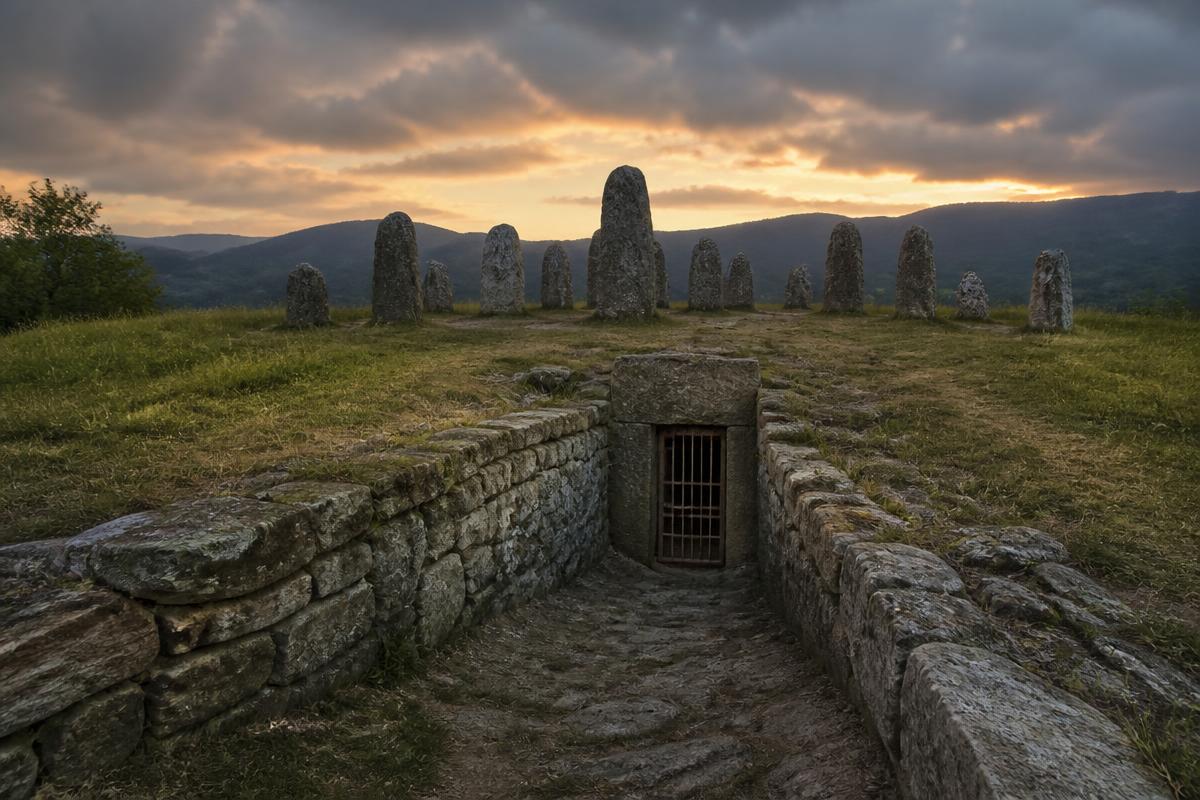
The Thracians left no empire and almost no writing — but they left gold, rock and geometry. Some 15 000 burial mounds dot the land, and the finest of them hold frescoed chambers, caryatids and altars cut straight into cliffs.
Thracian site
Thracian Tumulus, Krotiriya
Тракийска могила, м. Кротирия
A Thracian burial mound in the Krotiriya locality west of Pomorie, in the necropolis landscape of ancient Anchialos — near the famous beehive domed tomb of the same coast.
Region
Pomorie, Black Sea Coast
Era
4th–3rd century BC
tumulus
Anchialos
near Pomorie
Thracian site
Thracian Tomb of Kazanlak
UNESCO-listed 4th-century BC beehive tomb whose funeral-feast frescoes are the finest Hellenistic paintings in south-east Europe.
Region
Valley of the Thracian Kings
Era
4th century BC
UNESCO
UNESCO
frescoes
Valley of Kings
Thracian site
Thracian Tomb of Sveshtari
UNESCO tomb of a Getic ruler, famous for ten caryatids carved as women holding up the burial chamber.
Region
Ludogorie
Era
3rd century BC
UNESCO
UNESCO
caryatids
Getae
Thracian site
Perperikon
A whole city cut into rock — sacred hilltop complex with a wine-ritual altar, thought to hold the oracle of Dionysus.
Region
Eastern Rhodopes
Era
5th millennium BC – Middle Ages
rock city
oracle
Dionysus
Thracian site
Tatul Sanctuary
Truncated rock pyramid with sarcophagi cut into the summit, linked in legend to the tomb of Orpheus.
Region
Eastern Rhodopes
Era
Late Bronze Age
Orpheus
rock-cut
sunrise spot
Thracian site
Starosel Cult Complex
The largest Thracian royal temple found so far, a colonnaded mausoleum inside a mound, ringed by vineyards.
Region
Sredna Gora
Era
5th century BC
royal temple
wine
largest
Thracian site
Seuthopolis
Capital of King Seuthes III, now submerged beneath the Koprinka reservoir — visible in dry seasons and mapped from the shore.
Region
Valley of the Thracian Kings
Era
4th century BC
sunken city
royal capital
reservoir
Thracian site
Golyama Kosmatka Tomb
Where the gold laurel wreath and bronze head of Seuthes III were found; a long stone corridor leads into the burial chamber.
Region
Valley of the Thracian Kings
Era
Late 4th century BC
gold treasure
Seuthes III
corridor tomb
Thracian site
Beglik Tash
Megalithic sanctuary of rounded boulders above the sea near Primorsko, with a sun clock, labyrinth and sacrificial altar.
Region
Black Sea, Strandzha
Era
2nd millennium BC
megaliths
sea views
sun calendar
Thracian site
Mishkova Niva
Domed tomb and heroon deep in Strandzha's oak forest near Malko Tarnovo, reached by a forest track.
Region
Strandzha
Era
3rd century BC
forest
heroon
remote
Thracian site
Aleksandrovo Tomb
Hunting-scene murals of extraordinary energy, shown through a full-scale replica and museum beside the original mound.
Region
Thrace
Era
4th century BC
murals
replica museum
hunt scenes
Thracian site
Shushmanets Tomb
Rare domed tomb with a single central Ionic column, part of the dense mound field around Shipka village.
Region
Valley of the Thracian Kings
Era
5th–4th century BC
Ionic column
mound field
Shipka
Thracian site
Tsari Mali Grad
Hilltop fortress with Thracian sanctuary roots above Belchin, an easy detour from the Sapareva Banya thermal cluster.
Region
Belchin, Rila foothills
Era
Thracian – Late Antiquity
fortress
restored
family friendly
Context
Why the water and the tombs sit together
Thracian sanctuaries cluster around springs and hot water: the sources were sacred long before Rome piped them. Almost every thermal town on this site has a mound, sanctuary or rock altar within a short ride.