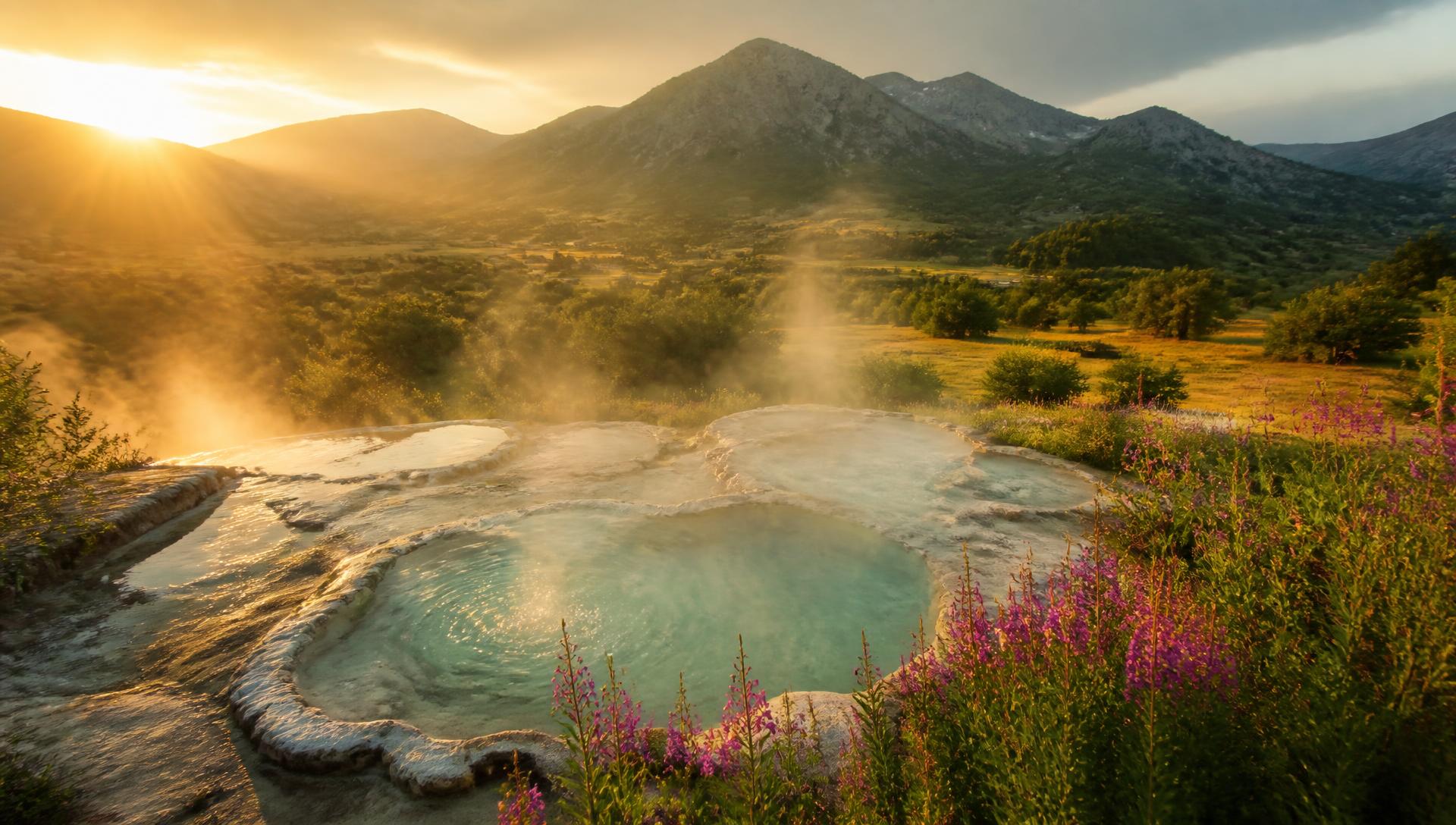
Bulgaria sits on one of the richest hydrothermal fields in Europe: more than 500 registered sources, from naturally sparkling cold water in the Rhodope gorges to a 103°C geyser in the middle of a Rila town. These 33 are the ones to plan a trip around.
Showing 33 of 33 sources
Thermal bath
Sapareva Banya Geyser
Сапарева баня (гейзер)
The hottest geyser in continental Europe erupts at 103°C in the middle of town; the field ranges 31–104°C and feeds cooled pools and a mineral beach at the foot of Rila.
Spa capital of the Balkans: three separate deposits under one town. Kamenitsa runs 62–88.5°C with a sulphur bath, Ladzhene carries an extraordinary 55 mg/L fluoride, Chepino is the mildest of the three.
Region
Rhodopes
Source
88°C
pH
8.3
Mineralisation
55 mg/L
Water
Sulphate-hydrocarbonate sodium, hyperthermal, very low mineralisation
Hot water at the foot of the extinct Kozhuh volcano, 71–78°C and heavily charged with carbon dioxide — a place of pilgrimage linked with the mystic Baba Vanga.
Ancient Pautalia's thermae still run at 73–74°C under the town — strongly sulphurous, highly alkaline, with the Roman bath ruins in the centre and Osogovo above.
Hydrogen sulphide · Sulphate · Fluoride · Very low hardness
Roman thermae
73°C
pH 9.15
Thermal bath
Dolna Banya
Долна баня
Warm pools between Rila and Ihtiman at 62–65°C. Fluoride is high enough that the water is for bathing, not drinking; the separate 'Byalata voda' spring runs at 26°C.
Region
Rila
Source
63°C
pH
8.8
Mineralisation
550 mg/L
Water
Sulphate-sodium with hydrocarbonate and fluoride
Key minerals
Fluoride 11.64 mg/L — not for drinking · Sulphate · Weak radioactivity
weekend
Rila
bathing only
Thermal bath
Marikostinovo
Марикостиново
A field of springs from 35°C to 63°C near the Greek border, feeding rustic baths in a warm Mediterranean-tinged valley.
Rehabilitation town in the Rose Valley between the Balkan range and Sredna Gora, with one of the most radon-rich and fluoride-rich waters in the country.
Roman Diocletianopolis: 22 springs bubbling inside the best-preserved Roman fortress walls in Bulgaria, from 26°C up to 52°C. Water prescribed for kidneys since antiquity.
Region
Upper Thracian Plain
Source
52°C
Mineralisation
253 mg/L
Water
Hydrocarbonate-sulphate sodium, alkaline, very low hardness
Key minerals
Fluoride · Metasilicic acid · Radon traces
Roman walls
22 springs
kidney cure
Thermal bath
Banya (Karlovo)
Баня, Карловско (Карловски минерални бани)
Small village with big water — the central bore rises at 49.5°C into open-air pools looking straight at the Botev massif, faintly sulphurous.
Low-key baths on the plain east of Sliven at 48°C — mineral-dense and lightly carbonated, a useful warm stop between the Blue Rocks and the Valley of Thracian Kings.
Thracian- and Roman-used springs in the Haskovo hills, redeveloped as a small spa village with public taps and hotel pools.
Region
Thrace
Source
48°C
pH
7.9
Mineralisation
700 mg/L
Water
Hydrocarbonate-sulphate sodium, fluoride and silica bearing
Key minerals
Fluoride · Metasilicic acid · Sodium · Sulphate
Roman use
spa village
Thrace
Mineral spring
Sofia Central Mineral Baths
Централна минерална баня (находище София-Център)
The city's Vienna-Secession landmark, with free public taps outside where Sofians fill bottles from a 46°C source used since Roman Serdica.
Region
Sofia
Source
46°C
Mineralisation
309 mg/L
Water
Hydrocarbonate-sodium, low mineralisation
Key minerals
Hydrogen carbonate · Sodium · Sulphate
free taps
landmark
Roman heritage
Thermal bath
Banite
Баните, Смолянско
Deep-Rhodope village whose 43°C radon water is used for joint and spine therapy; quiet, cheap and surrounded by walnut groves. Full ion analysis is not published.
Region
Rhodopes
Source
43°C
Water
Radon bearing, hydrocarbonate-sodium
Key minerals
Radon · Fluoride
radon
joints
quiet
Thermal bath
Dobrinishte
Добринище
Seventeen springs at the mouth of the Desilitsa valley, a short ride from Bansko — the hottest of them tops 43°C at the old bathhouse.
Bulgaria's best-known bottled water town, wrapped in Rhodope pine forest. Its borehole water is strikingly alkaline — pH 9.56 — and silicic-rich, with warm public baths in town.
Mountain hamlet near Troyan with small family baths. Unusually for Bulgaria the water is sulphate-calcium rather than sodium — the natural springs run 33–37°C.
Region
Balkan Mountains
Source
37°C
pH
7.45
Mineralisation
700 mg/L
Water
Sulphate-calcium (magnesium) — rare type in Bulgaria
Sulphurous city baths in western Sofia — locally 'Zhezhkata voda', the hot water — part of the bath tradition that gave Roman Serdica its thermae. No official analysis is published for this source.
Region
Sofia
Source
30°C
Water
Sulphide, sodium sulphate (composition not officially published)
Sofia
sulphur
urban bath
Mineral spring
Gorna Banya
Горна баня (София)
Sofia's household drinking water, tapped on the eastern foot of Lyulin and carried home in bottles from the public fountains beside the old bath.
Region
Sofia
Source
29°C
pH
9.3
Mineralisation
260 mg/L
Water
Hydrocarbonate-sulphate sodium, very low mineralisation
Seaside spa town built on a sand spit, where mineral springs meet the famous healing mud and lye of hypersaline Pomorie Lake — used since Thracian times for joints, skin and rheumatism.
Region
Black Sea Coast
Water
Chloride-sodium mineral water + estuary mud and lye (rapa)
healing mud
Black Sea
rapa
spit
Mineral spring
Atanasovsko Lake Salt Pans
Солниците — Атанасовско езеро
Bulgaria's salt garden: pink hypersaline pools north of Burgas where salt has been harvested since antiquity. Flat salt paths circle the pans — ideal easy riding among flamingos and pelicans, with black healing mud and lye baths along the shore.
Region
Burgas, Black Sea Coast
Water
Hypersaline lagoon — salt pans, healing mud and lye
salt paths
flamingos
healing mud
flat riding
Bulgarian mineral water, in short
Where is the hottest mineral spring in Bulgaria?
Sapareva Banya, at the foot of Rila, holds the hottest water on the Balkan peninsula — a geyser fountain reaching about 103 °C. Kyustendil (73 °C) and Velingrad's Kamenitsa group follow.
Which towns are the classic mineral bath resorts?
Velingrad is called the spa capital of the Balkans; Hisarya, Sandanski, Devin, Bankya, Sapareva Banya, Pavel Banya, Momin Prohod, Ognyanovo, Dobrinishte and Narechenski Bani each built their balneology around a named source with its own chemistry.
Can you drink Bulgarian mineral water straight from the spring?
Many public drinking fountains are fed directly from tapped boreholes and are used daily by locals — Devin, Gorna Banya, Bankya, Mihalkovo and Narechenski Bani among them. Very hot or highly mineralised waters, and radon waters such as Momin Prohod, are for bathing or prescribed courses rather than free drinking.
How many mineral springs does Bulgaria have?
Over 500 registered sources across more than 200 deposits — the densest concentration in continental Europe after Iceland. Temperatures run from cold carbonated water at 12 °C to the Sapareva geyser, and the chemistry ranges from very soft alkaline water to strongly mineralised sulphate springs.