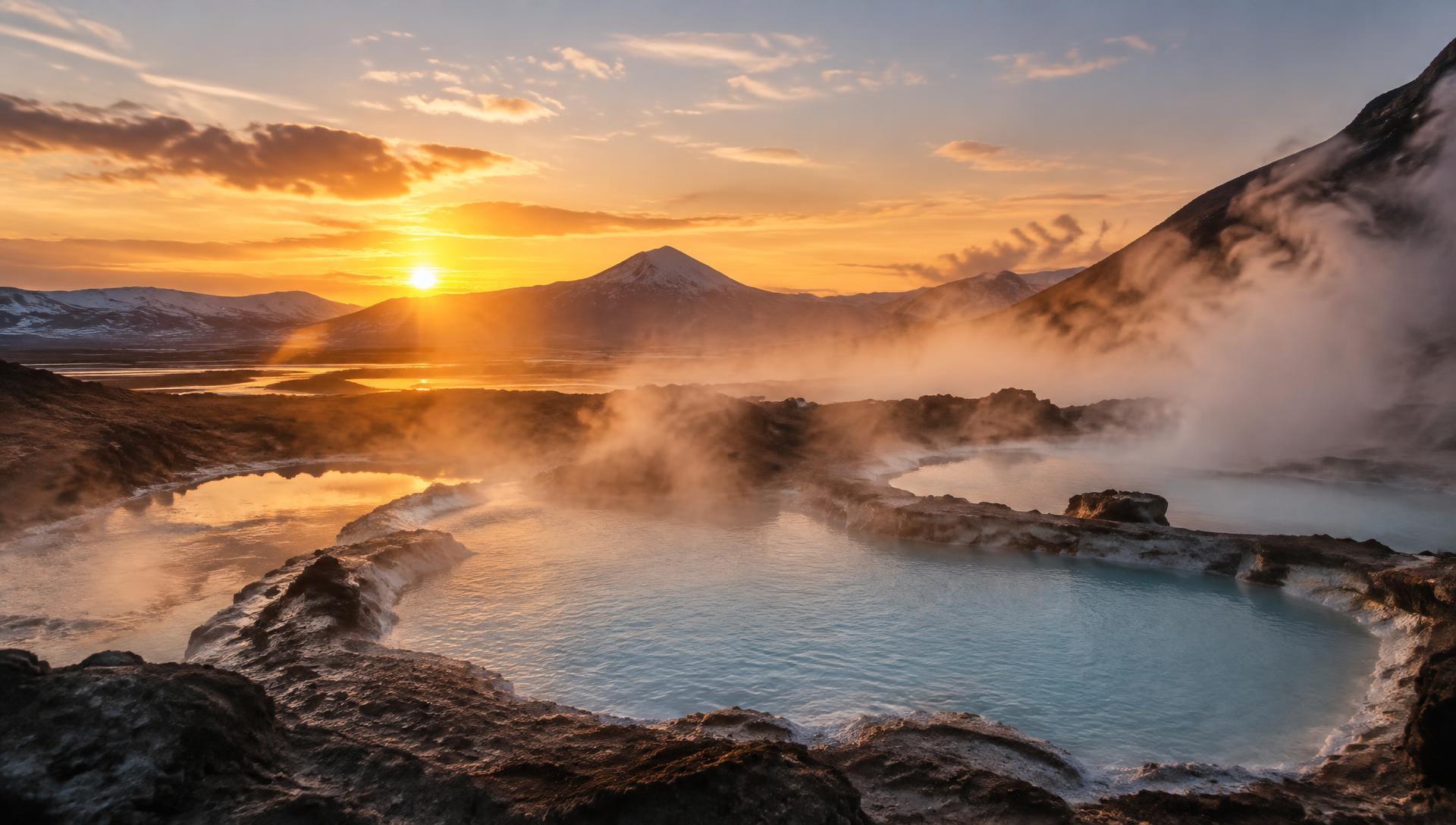
The same catalogue, opened up to the planet. Every entry carries its source temperature, pH and mineral signature, so an Icelandic silica lagoon and a Rhodope carbonated spring can be read side by side. 50 countries across 6 continents — Bulgaria remains the deepest chapter.
Sources
86
Countries
50
Continents
6
Hottest shown
Sapareva Banya Geyser · 103°C
Thermal bath
Sapareva Banya Geyser
Сапарева баня (гейзер)
The hottest geyser in continental Europe erupts at 103°C in the middle of town; the field ranges 31–104°C and feeds cooled pools and a mineral beach at the foot of Rila.
The second-largest geyser field on earth, roughly ninety vents in a remote Kamchatka canyon reached only by helicopter.
Region
Kamchatka
Source
95°C
pH
8
Water
Alkaline chloride-bicarbonate geothermal water
Key minerals
Silica · Chloride · Bicarbonate · Arsenic traces
UNESCO
UNESCO
geyser field
helicopter access
Thermal bath🇮🇳 India
Manikaran
मणिकरण
Near-boiling water beside the Parvati river, hot enough that pilgrims cook rice in cloth bundles at the Sikh and Hindu shrines.
Region
Himachal Pradesh
Source
94°C
pH
7.8
Mineralisation
1,300 mg/L
Water
Sodium sulphate-bicarbonate geothermal water
Key minerals
Sodium sulphate · Bicarbonate · Silica · Sulphur
pilgrimage
cooking springs
Parvati valley
Mineral spring
Velingrad
Велинград (Каменица, Чепино, Лъджене)
Spa capital of the Balkans: three separate deposits under one town. Kamenitsa runs 62–88.5°C with a sulphur bath, Ladzhene carries an extraordinary 55 mg/L fluoride, Chepino is the mildest of the three.
Region
Rhodopes
Source
88°C
pH
8.3
Mineralisation
55 mg/L
Water
Sulphate-hydrocarbonate sodium, hyperthermal, very low mineralisation
The bath where Atahualpa was resting when Pizarro arrived in 1532 — still running at 78°C in the Cajamarca valley.
Region
Cajamarca
Source
78°C
Highest point
· 2667 m
pH
7.4
Mineralisation
2,400 mg/L
Water
Sodium chloride-sulphate thermal water
Key minerals
Sodium chloride · Sulphate · Calcium · Silica
Inca history
1532
Andean valley
Thermal bath
Rupite
Рупите (Кожух)
Hot water at the foot of the extinct Kozhuh volcano, 71–78°C and heavily charged with carbon dioxide — a place of pilgrimage linked with the mystic Baba Vanga.
Ancient Pautalia's thermae still run at 73–74°C under the town — strongly sulphurous, highly alkaline, with the Roman bath ruins in the centre and Osogovo above.
Galicia's thermal city: 68°C water pours out in the middle of Ourense and again in free riverside pools along the Miño.
Region
Galicia
Source
68°C
pH
7.6
Mineralisation
480 mg/L
Water
Sodium bicarbonate-fluoride water, silica rich
Key minerals
Sodium bicarbonate · Fluoride · Silica · Lithium
free river pools
city springs
Camino
Thermal bath🇹🇼 Taiwan
Beitou Hot Springs
北投溫泉
Taipei's steaming valley of public and private baths, source of the rare radioactive mineral hokutolite.
Region
Taipei
Source
65°C
pH
1.6
Water
Strongly acidic sulphate-chloride (green sulphur) water
Key minerals
Sulphuric acid · Chloride · Radium (hokutolite) · Iron
Thermal Valley
hokutolite
city baths
Thermal bath
Dolna Banya
Долна баня
Warm pools between Rila and Ihtiman at 62–65°C. Fluoride is high enough that the water is for bathing, not drinking; the separate 'Byalata voda' spring runs at 26°C.
Region
Rila
Source
63°C
pH
8.8
Mineralisation
550 mg/L
Water
Sulphate-sodium with hydrocarbonate and fluoride
Key minerals
Fluoride 11.64 mg/L — not for drinking · Sulphate · Weak radioactivity
weekend
Rila
bathing only
Thermal bath
Marikostinovo
Марикостиново
A field of springs from 35°C to 63°C near the Greek border, feeding rustic baths in a warm Mediterranean-tinged valley.
Poland's oldest spa, documented in 1281, drawing fluoride-rich water from granite under the Karkonosze foothills.
Region
Lower Silesia
Source
62°C
pH
8.2
Mineralisation
600 mg/L
Water
Fluoride-silica sodium sulphate thermal water
Key minerals
Fluoride · Silica · Sodium sulphate · Bicarbonate
oldest Polish spa
granite aquifer
1281
Thermal bath
Pavel Banya
Павел баня
Rehabilitation town in the Rose Valley between the Balkan range and Sredna Gora, with one of the most radon-rich and fluoride-rich waters in the country.
'The pot that boils on its own' in Tswana: 22 000 litres an hour of sodium-chloride water in the bushveld north of Pretoria.
Region
Limpopo
Source
53°C
pH
7.4
Mineralisation
4,600 mg/L
Water
Sodium chloride-carbonate thermal water
Key minerals
Sodium chloride · Carbonate · Calcium · Fluoride
bushveld
Tswana name
family resort
Mineral spring
Hisarya
Хисаря (Диоклецианополис)
Roman Diocletianopolis: 22 springs bubbling inside the best-preserved Roman fortress walls in Bulgaria, from 26°C up to 52°C. Water prescribed for kidneys since antiquity.
Region
Upper Thracian Plain
Source
52°C
Mineralisation
253 mg/L
Water
Hydrocarbonate-sulphate sodium, alkaline, very low hardness
Key minerals
Fluoride · Metasilicic acid · Radon traces
Roman walls
22 springs
kidney cure
Thermal bath🇳🇿 New Zealand
Hanmer Springs
Hanmer Springs
Alpine pools in a South Island forest basin, fed by water rising along the Hanmer fault at up to 52°C.
Region
Canterbury
Source
52°C
pH
7.8
Mineralisation
1,000 mg/L
Water
Sodium chloride-bicarbonate thermal water
Key minerals
Sodium chloride · Bicarbonate · Silica · Sulphate
alpine pools
fault spring
South Island
Thermal bath🇯🇵 Japan
Kusatsu Onsen
草津温泉
Ferociously acidic sulphur water cooled by hand in wooden yubatake channels in the middle of the village.
Low-key baths on the plain east of Sliven at 48°C — mineral-dense and lightly carbonated, a useful warm stop between the Blue Rocks and the Valley of Thracian Kings.
Milky, acidic sulphur water running out of the Tangkuban Perahu volcano into tea-plantation pools north of Bandung.
Region
West Java
Source
46°C
pH
3.4
Mineralisation
1,800 mg/L
Water
Acidic sulphate volcanic water
Key minerals
Sulphate · Free sulphuric acid · Iron · Aluminium
volcano
tea plantations
acidic
Thermal bath🇮🇷 Iran
Sarein
سرعین
Nine springs on the flank of Mount Sabalan, Iran's best-known bathing town, iron-rich and lightly carbonated.
Region
Ardabil
Source
46°C
pH
6.4
Mineralisation
3,200 mg/L
Water
Carbonated bicarbonate-sulphate calcium water, iron bearing
Key minerals
Iron · Carbon dioxide · Bicarbonate · Calcium · Magnesium
Sabalan volcano
iron rich
nine springs
Thermal bath🇳🇿 New Zealand
Rotorua Geothermal Field
Rotorua
Geysers, mud pools and Māori bathing traditions across a live caldera; Polynesian Spa mixes acidic and alkaline springs.
Region
Bay of Plenty
Source
45°C
pH
2.5
Water
Acidic sulphate (Priest spring) and alkaline sodium chloride (Rachel spring)
Key minerals
Sulphur · Silica · Sodium chloride · Bicarbonate
geysers
mud pools
Māori heritage
Thermal bath
Banite
Баните, Смолянско
Deep-Rhodope village whose 43°C radon water is used for joint and spine therapy; quiet, cheap and surrounded by walnut groves. Full ion analysis is not published.
Region
Rhodopes
Source
43°C
Water
Radon bearing, hydrocarbonate-sodium
Key minerals
Radon · Fluoride
radon
joints
quiet
Thermal bath
Dobrinishte
Добринище
Seventeen springs at the mouth of the Desilitsa valley, a short ride from Bansko — the hottest of them tops 43°C at the old bathhouse.
Grey mud pools and hot rinse pools at the foot of the Sabeto range near Nadi, used village-style with a full mud coating first.
Region
Viti Levu
Source
42°C
pH
7.6
Mineralisation
1,200 mg/L
Water
Sodium bicarbonate-chloride water with volcanic mud
Key minerals
Sodium bicarbonate · Chloride · Silica · Sulphur
mud pools
Nadi
village run
Mineral spring
Devin
Девин (сондаж №5)
Bulgaria's best-known bottled water town, wrapped in Rhodope pine forest. Its borehole water is strikingly alkaline — pH 9.56 — and silicic-rich, with warm public baths in town.
Mountain hamlet near Troyan with small family baths. Unusually for Bulgaria the water is sulphate-calcium rather than sodium — the natural springs run 33–37°C.
Region
Balkan Mountains
Source
37°C
pH
7.45
Mineralisation
700 mg/L
Water
Sulphate-calcium (magnesium) — rare type in Bulgaria
Eight stepped pools in a reed-lined gorge at 3 500 m in the Atacama desert, at a steady 33°C.
Region
Atacama
Source
33°C
Highest point
· 3475 m
pH
7.5
Water
Sodium sulphate-chloride water of volcanic origin
Key minerals
Sodium sulphate · Chloride · Silica · Lithium
high desert
stepped pools
Atacama
Thermal bath
Ovcha Kupel Baths
Минерална баня Овча купел
Sulphurous city baths in western Sofia — locally 'Zhezhkata voda', the hot water — part of the bath tradition that gave Roman Serdica its thermae. No official analysis is published for this source.
Region
Sofia
Source
30°C
Water
Sulphide, sodium sulphate (composition not officially published)
Sofia
sulphur
urban bath
Thermal bath🇧🇴 Bolivia
Termas de Polques
Termas de Polques
A single walled pool at 4 400 m on the Bolivian altiplano, beside the Salar de Chalviri and the Sol de Mañana geysers.
Seaside spa town built on a sand spit, where mineral springs meet the famous healing mud and lye of hypersaline Pomorie Lake — used since Thracian times for joints, skin and rheumatism.
Region
Black Sea Coast
Water
Chloride-sodium mineral water + estuary mud and lye (rapa)
healing mud
Black Sea
rapa
spit
Mineral spring
Atanasovsko Lake Salt Pans
Солниците — Атанасовско езеро
Bulgaria's salt garden: pink hypersaline pools north of Burgas where salt has been harvested since antiquity. Flat salt paths circle the pans — ideal easy riding among flamingos and pelicans, with black healing mud and lye baths along the shore.
Region
Burgas, Black Sea Coast
Water
Hypersaline lagoon — salt pans, healing mud and lye
salt paths
flamingos
healing mud
flat riding
How this grows
Reading water across borders
Three numbers make hot springs comparable anywhere: temperature at the source, pH, and total mineralisation. Kusatsu in Japan is fiercely acidic at pH 2.1; Devin in the Rhodopes is alkaline at 9.56 with almost nothing dissolved in it; Mihalkovo carries nearly 2 900 mg/L and a kilogram of carbon dioxide per cubic metre. Same planet, same plumbing, wildly different water.